A roof's material decides how long it lasts and how much weight the framing has to hold up. In fire country it also decides whether the roof meets California's rules. Below are 8 common materials ranked by typical lifespan, with the weight, fire rating and, where a public study priced it, the cost of each.
The short version
- On typical lifespan, slate ranks first, then clay tile, concrete tile, metal, architectural shingles, fiber cement, wood shakes and 3-tab shingles.
- By the tile industry's own figures, tile and slate weigh 600 to 3,300 pounds per 100 square feet, against 275 to 425 pounds for asphalt shingles.
- Composition shingles, flat or barrel tile and standing seam steel can each be Class A on their own, which is the top fire rating.
- If your house has never had a tile or slate roof, have the framing inspected before you switch to one.
How did we rank the roofs?
We ranked them by typical lifespan, because it's the one measure that a single public chart gives for every material here. The chart is the Standard Estimated Life Expectancy Chart from InterNACHI, the International Association of Certified Home Inspectors. Its figures assume regular maintenance and normal wear.
For slate and clay tile, we also read the National Park Service's preservation briefs, which give lifespans for historic roofs. Where the 2 sources differ, the table shows both.
When 2 materials tied, the one that can be Class A on its own ranked higher. We didn't rank on price, because prices change from one region and year to the next.
A roof's life also depends on how it's put on. The Park Service says that worn flashing, valleys and gutters "can also lead to the failure of a clay tile roof," and the same goes for any roof.
Roofers weigh and price roofs by the square, which is 100 square feet. The weights below are per square, from the Tile Roofing Industry Alliance. It's a trade group for tile makers. It calls its numbers approximate.
The ranking at a glance
| Rank | Material | Typical lifespan | Weight per square | Fire rating |
|---|---|---|---|---|
| 1 | Slate | 60 to 150 years (InterNACHI). 60 to 125 years or longer (Park Service) | 900 to 3,300 lb, depending on thickness | Check the product's listing |
| 2 | Clay tile | 100 years or more (InterNACHI). About 100 years (Park Service) | 600 to 950 lb | Flat or barrel tile can be Class A on its own |
| 3 | Concrete tile | 100 years or more (InterNACHI, listed with clay) | 700 to 950 lb | Flat or barrel tile can be Class A on its own |
| 4 | Metal | 40 to 80 years, copper 70 or more (InterNACHI) | Copper 100 to 125 lb. Steel weighs about half as much as asphalt (Metal Roofing Alliance) | Standing seam steel can be Class A on its own |
| 5 | Architectural asphalt shingles | 30 years (InterNACHI) | 275 to 425 lb | Class A, B or C, so check the label |
| 6 | Fiber cement | 25 years (InterNACHI) | We didn't find a public figure | Check the product's listing |
| 7 | Wood shakes and shingles | 25 years (InterNACHI) | 450 to 600 lb | Class A only by assembly, when fire-retardant-treated |
| 8 | 3-tab asphalt shingles | 20 years (InterNACHI) | 275 to 425 lb | Class A, B or C, so check the label |
The fire ratings come from a 2024 Headwaters Economics study of wildfire retrofits in California and from the Asphalt Roofing Manufacturers Association. Class A is the highest of the 3 fire ratings a roof can have.
1. Slate
Slate lasts longer than any other roof here. The National Park Service says a properly installed slate roof will last "60 to 125 years or longer." How long depends on the slate, the roof's shape and where the house is. It adds that some slates have lasted over 200 years.
It's also the heaviest roof by a wide margin. The tile industry's table puts slate at 900 to 3,300 pounds per square, depending on how thick it is.
Slate is hard to live with in one way, because you can't walk on it freely. The Park Service says to keep foot traffic off a slate roof. Anyone who has to go up should walk on a ladder hooked over the ridge. That matters whenever someone needs to reach a chimney, a vent or solar panels.
Snow country is harder on it too. The Park Service's roofing brief says slate is "very susceptible to breakage by ice, or ice dams."
Verdict: slate suits a house built to carry it. On a house framed for shingles, plan on a structural inspection before you get a bid.
2. Clay tile
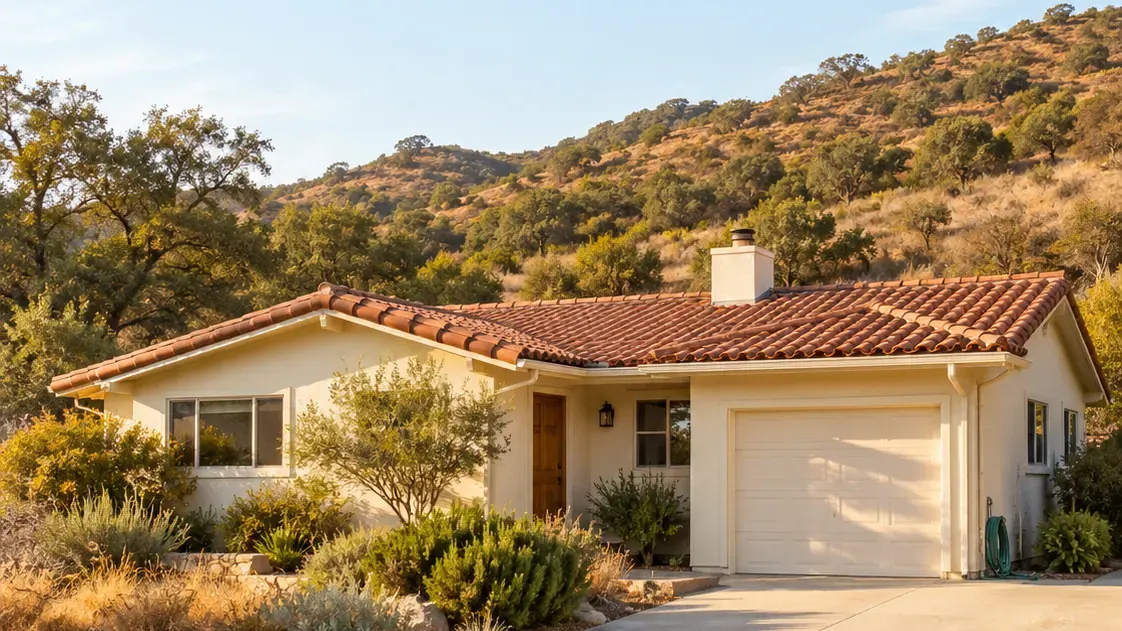
Clay tile is the longest-lasting roof after slate. The Park Service says clay tile has "one of the longest life expectancies among historic roofing materials," generally about 100 years. InterNACHI lists clay and concrete tile at 100 years or more.
The tile industry's table puts clay tile at 600 to 950 pounds per square. It says the weight varies with the tile's profile and how it's installed.
Flat and barrel tile can be Class A on their own, according to the Headwaters study. Curved tile leaves gaps between the tile and the roof deck. In fire hazard zones, California's wildfire building rules require those gaps to be plugged with a noncombustible bird stop to keep embers out.
Tile breaks if it's walked on the wrong way. The Park Service says high-profile tiles are "very fragile and easily broken," so roofers spread their weight on plywood, planks or sandbags.
The framing under the tile needs care too. The Park Service says water that backs up under tiles can rot the battens and sheathing, "or even the roof's structural members."
Verdict: if your house has tile now, clay tile is the longest-lasting way to keep it. Have a roofer check the sheathing and framing before the new tile goes on.
3. Concrete tile
Concrete tile gives you the look of clay for less. The Park Service says it reproduces the general look of clay tile "at a somewhat lower cost and weight."
The tile industry's own table doesn't show much of a weight gap, though. It puts concrete tile at 700 to 950 pounds per square, which overlaps clay's range. Ask for the weight of the exact tile you're quoted.
Concrete tile shares clay's 100-year figure in InterNACHI's chart. We ranked it a place lower because the Park Service's 100-year figure is for clay. We didn't find a public source that gives concrete tile its own figure. The Park Service also says concrete tile "tends to lack the color permanence" of natural clay.
Its fire rating works the same way as clay's. Flat and barrel concrete tile can be Class A on their own. Curved tile needs bird stops at the edges.
Verdict: concrete tile is the value pick for a house that's already framed for tile.
4. Metal
Metal is the lightest roof on this list. It's also one of the longest-lasting. InterNACHI gives metal roofs 40 to 80 years and copper roofs 70 years or more. The Metal Roofing Alliance, a trade group, says metal roofing lasts "50-plus years."
The same group says metal roofing "weighs half as much as asphalt." The tile industry's table puts copper at 100 to 125 pounds per square.
Standing seam steel panels can be Class A on their own, according to the Headwaters study. A metal roof with gaps between the panels and the roof deck needs bird stops in fire hazard zones, the same as curved tile.
It costs more up front than shingles. Headwaters priced standing seam steel with a fire-resistant underlayment at $18.68 a square foot in northern California, from 2023 construction cost data. That's about 3 times its figure for composition shingles.
Then there's rain noise. The Metal Roofing Alliance says "there is little difference between metal and other materials" when it comes to noise from rain or hail. That's the industry's own claim.
Our comparison of metal and tile roofs side by side goes through weight, lifespan and walking on each one.
Verdict: metal is the longest-lasting roof you can put on a house framed for shingles without adding weight.
5. Architectural asphalt shingles
Architectural shingles are the thicker, layered kind of asphalt shingle. InterNACHI gives them 30 years, which is 10 more than the flat 3-tab kind.
Asphalt shingles are by far the most common roof. The Asphalt Roofing Manufacturers Association says "four out of five homes are roofed with asphalt shingles." The tile industry's table puts asphalt shingles at 275 to 425 pounds per square.
Don't assume a shingle is Class A. The manufacturers' association says asphalt shingles carry Class A, B or C fire ratings, so check the label on the bundle or the bid. Headwaters names asphalt fiberglass composition shingles as Class A on their own. It says most roof coverings are Class A because those shingles are so popular and affordable.
They also cost the least of the roofs Headwaters priced. Class A composition shingles with a fire-resistant synthetic underlayment came to $6.29 a square foot in northern California. That figure includes materials, labor, tearing off the old roof and contractor overhead. Headwaters says southern California's costs were generally within 10% of that.
The study's figures leave out surprises found when the old roof comes off, such as rotted underlayment. Budget for those separately.
For the difference between the 2 kinds of asphalt shingle, see our architectural vs 3-tab comparison.
Verdict: architectural shingles give most shingle-framed houses the most years for the money.
6. Fiber cement
Fiber cement roofing is made of cement mixed with mineral fiber. InterNACHI gives it 25 years.
The Park Service describes fiber cement tile as a "slightly cheaper and lighter substitute for clay tile." We didn't find a public weight figure or fire rating that covers fiber cement roofing as a group. Ask for both on the product you're quoted.
Verdict: fiber cement can give you a tile look with less weight. Compare its lifespan with architectural shingles before you pay more for it.
7. Wood shakes and shingles
InterNACHI lists wood roofs at 25 years. The tile industry's table puts wood shakes at 450 to 600 pounds per square, which is heavier than asphalt.
Wood is the only material here that can't be Class A on its own. Headwaters says fire-retardant-treated wood shakes and shingles reach Class A only "by assembly." That means they need a material underneath or a special way of installing them.
The same study says replacing a wood shake or shingle roof that isn't fire-retardant-treated is the top priority for a home's wildfire resistance.
Verdict: if you have a wood roof now, replace it with one of the Class A materials ranked above it.
8. 3-tab asphalt shingles
The flat 3-tab shingle has the shortest life on this list. InterNACHI gives it 20 years. The manufacturers' association says a roof more than 20 years old "is a prime candidate for reroofing."
It weighs the same as architectural shingles. Its fire rating can be Class A, B or C, so check the label. Our architectural vs 3-tab comparison covers how the 2 compare on wind and looks.
Verdict: 3-tab shingles cost less up front but give you the fewest years of any roof here.
Where do flat roofs fit?
They aren't ranked here, because flat and low-slope roofs use different materials. Those include built-up roofing, modified bitumen, TPO and EPDM rubber. InterNACHI gives them between 7 and 30 years.
We rank them on their own in flat roof materials for California homes, ranked.
Does California's fire code limit your choice?
In a fire hazard zone, yes. The Headwaters study says California's wildfire building rules require a Class A roof there, either on its own or by assembly.
Most of the materials above can meet that rule. Wood is the exception, because it needs a fire-retardant treatment and a special assembly to get there.
Insurers notice the rating too. If your home is on the FAIR Plan, its discount sheet lists a Class A roof. It names asphalt fiberglass composition shingles, stone, concrete or clay tile, or metal.
Once the new roof is on, keep the roofer's invoice and the fire rating label from the product. Send copies to whoever insures the house, because an insurer can only credit a roof it knows about. Casa quotes homes in California's fire hazard zones with standard insurers first and then specialty insurers, and a licensed agent reviews every quote. Casa's guide to home hardening and your premium, from the team that runs this site, puts a Class A roof at the top of its list and explains why undocumented work doesn't count.
Does California's energy code affect the choice?
It can. The Cool Roof Rating Council says California's energy code has cool roof rules for single-family homes that apply to roof recoverings. The rules vary by climate zone, building type, roof size and slope.
Any roofing product used to meet them has to be rated by the Council. Your roofer or your building department can tell you whether your reroof needs a rated product.
Which roof fits your house?
Here's our pick for each common case:
- Your house has tile now. Stay with tile, clay for the longest life or concrete for a lower cost. Have the sheathing and framing checked first, because the Park Service says trapped water can rot them.
- Your house has shingles and you want the most years for the money. Choose architectural shingles with a Class A label. Headwaters priced them at about a third of the cost of standing seam steel.
- You want the longest life without adding weight. Choose metal. It's the lightest roof here. InterNACHI gives it 40 to 80 years.
- You want tile or slate on a house that's never had it. Have the framing inspected first. The Tile Roofing Industry Alliance says an inspection will show whether the structure needs more support.
- You have wood shakes. Replace them with a Class A material, which the Headwaters study calls the top priority for an untreated wood roof.
Once you've picked a material, get more than one bid. Our guide on how to compare roofing bids goes through them line by line.
Questions people ask
What's the longest-lasting roof material?
Slate, then clay tile. The National Park Service says a properly installed slate roof lasts 60 to 125 years or longer. It puts clay tile at about 100 years.
Is a tile roof too heavy for my house?
It depends on how the house is framed. The Tile Roofing Industry Alliance says that if a home hasn't had a tile or slate roof before, an inspection will show whether it needs more support. Tile weighs about 600 to 950 pounds per square, against 275 to 425 for asphalt shingles.
Is a metal roof loud in the rain?
The Metal Roofing Alliance, a trade group, says there's little difference between metal and other roofs when it comes to noise from rain or hail.
Can a new roof go over the old one?
Sometimes. The Asphalt Roofing Manufacturers Association says shingles can often go over an existing roof, but some local rules forbid reroofing over 2 or more layers. Ask your building department before you agree to an overlay.
How long does a composition shingle roof last?
InterNACHI's chart gives 20 years for 3-tab shingles and 30 years for architectural shingles, with regular maintenance. The shingle makers' association says a roof more than 20 years old is a prime candidate for reroofing.
Sources
- Standard Estimated Life Expectancy Chart for HomesInterNACHI
- Preservation Brief 29, Historic Slate RoofsNational Park Service
- Preservation Brief 30, Historic Clay Tile RoofsNational Park Service
- Preservation Brief 4, Roofing for Historic BuildingsNational Park Service
- Why Weight MattersTile Roofing Industry Alliance
- FAQsMetal Roofing Alliance
- Frequently Asked QuestionsAsphalt Roofing Manufacturers Association
- Retrofitting a Home for Wildfire Resistance (2024)Headwaters Economics
- Wildfire Hardening DiscountsCalifornia FAIR Plan
- California Title 24Cool Roof Rating Council